
Why So Many People Are Turning to Bookbinding Right Now
It’s easy to spend most of the day looking at a screen.
Work happens on laptops. Messages arrive on phones. Even our hobbies often live online.
And yet, over the past few years, we’ve noticed something interesting, more and more people are asking about learning bookbinding.
Sometimes it happens in the shop while someone is browsing notebooks.
Sometimes at events (like the Lost Trades Fair) when people see a finished book for the first time.
The question is often the same. “Do you teach bookbinding?"
It seems many people are feeling the same quiet pull, the desire to make something real with their hands.
A Return to Slower Crafts
Across the world there’s been a renewed interest in traditional crafts. Knitting. Pottery. Sewing. Woodworking. And increasingly, bookbinding.
Part of the appeal is the pace. These crafts invite you to slow down and pay attention to the process. They reward patience rather than speed.
There’s also something deeply satisfying about creating an object that will last — something you can hold, use, and keep.
A handmade object carries a story in a way that mass-produced things rarely do.
The Satisfaction of Making Something Useful
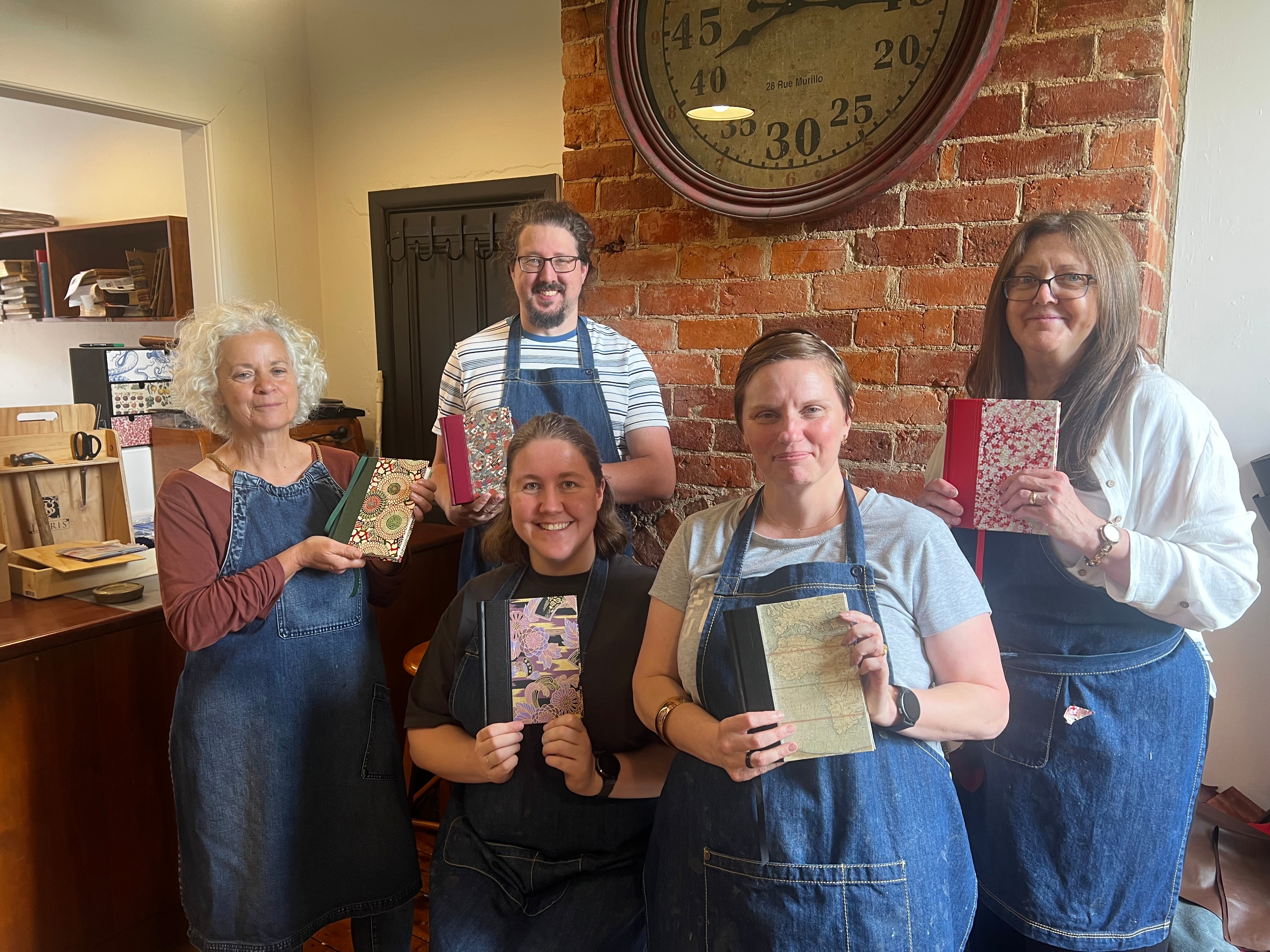
Bookbinding is a little different from many crafts because the result isn’t just decorative. You make something practical.
A handmade notebook can be used every day, for journaling, sketching, planning, or simply capturing ideas.
And when you’ve made the book yourself, the experience of using it changes. The pages feel different. The structure makes sense. You understand how the covers, spine, and stitching all work together.
It turns an ordinary object into something much more meaningful.
The Appeal of Learning a Traditional Craft
Bookbinding is also one of those crafts that carries a long history.
For centuries, books were made entirely by hand. Skilled craftspeople stitched pages together, shaped spines, and covered boards using techniques that have been passed down through generations.
Many of those methods are still used today. The tools themselves are surprisingly simple, needles, thread, paper, board, cloth.
When you learn bookbinding, you’re stepping into a craft that has been practiced for hundreds of years. There’s something special about becoming part of that tradition.
Why Beginners Are Curious About It
When people see bookbinding for the first time, the reaction is often immediate.
They’ll watch a demonstration or pick up a finished book and say something like: “I’ve always wanted to try that.” Or: “I love books and paper.”
Sometimes it’s simply: “That looks so calming.”
And they’re not wrong. The process can be surprisingly absorbing — measuring, folding, stitching, and slowly watching a book take shape.
From Curiosity to Learning
At some point curiosity usually turns into a different kind of question. Could I actually learn how to do this?
The answer is yes.
Like most traditional crafts, bookbinding is something that can be learned step by step. With the right guidance, beginners are often surprised by how quickly the structure of a book starts to make sense.
And once you’ve made your first one, the possibilities open up quickly.
Want to Learn More?
If learning bookbinding has been quietly sitting on your “one day” list, you’re not alone.
We’re currently preparing to relaunch our beginner-friendly online bookbinding course - The Beginner's Bookbinding Blueprint designed to help people take their first steps into the craft.
If you’d like to be the first to know when enrolments open — and receive early-bird pricing — you can join the waitlist below.


Leave a comment
This site is protected by hCaptcha and the hCaptcha Privacy Policy and Terms of Service apply.